EN
EN

News
CR2450HR TPMS Battery Selection Guide: How to Choose T25, T23, T26, T40 and Other Terminal Types
A CR2450HR battery can have the correct voltage, capacity and diameter and still be the wrong battery for a TPMS sensor.
The usual problem is not the coin cell itself. It is the terminal arrangement.
Tabs may point in the wrong direction, sit at the wrong height or place the positive and negative connections on opposite sides of the sensor PCB. Versions fitted with wires can also differ in cable length, connector pitch, locking direction and pin polarity.
That is why a complete CR2450HR part number—such as T25-03, SBO-T23, SBB-T26 or HAB-T40—matters when sourcing a tire-pressure monitoring system battery.
Quick Answer: How Do You Choose a CR2450HR TPMS Battery?
Check four areas before ordering:
-
Cell specification: Confirm the 3V output, capacity, dimensions, chemistry and discharge characteristics.
-
Temperature requirement: Use a battery designed for the temperatures expected inside the wheel and sensor assembly.
-
Terminal configuration: Compare the complete terminal code, tab position, dimensions and polarity.
-
Sensor interface: Determine whether the battery is soldered to a PCB, welded to another component or connected through wires and a plug.
Do not order by “CR2450HR” alone.
Whenever possible, send the supplier the complete battery code, TPMS sensor part number, a dimensioned drawing or clear photographs of the original battery installed in the sensor.
What Is a CR2450HR Battery?
CR2450HR is a heat-resistant, non-rechargeable lithium manganese dioxide coin cell commonly used in direct TPMS sensors and other automotive electronic devices.
In a direct TPMS, a battery-powered sensor mounted inside the wheel measures tire pressure and usually temperature. It then processes and transmits that information to a receiver in the vehicle.
The battery must tolerate changing temperatures, vibration and repeated acceleration while maintaining stable standby and pulse performance over a long service period.
A published CR2450HR reference datasheet lists the following values:
| Specification | CR2450HR reference value |
|---|---|
| Battery chemistry | Lithium manganese dioxide |
| Battery type | Primary, non-rechargeable |
| Nominal voltage | 3V |
| Nominal capacity | 550mAh |
| Nominal discharge current | 0.2mA |
| Cell diameter | 24.5mm |
| Cell height | 5.0mm |
| Cell weight | Approximately 6.8g |
| Operating temperature range | -40°C to +125°C |
| Acceleration resistance | Up to 2,000G |
These values apply to the referenced cell. The specifications of the battery actually being purchased must still be confirmed against its current datasheet.
Tabs, wires, insulation and connectors can change the weight and finished dimensions of the complete assembly.
The manufacturer also advises consultation when the battery will be used above 85°C. A maximum rating of 125°C should not be interpreted as approval for unlimited operation at 125°C under every load, duration and mounting condition.
Why Is CR2450HR Used in TPMS Sensors?
A TPMS sensor does more than take an occasional pressure reading.
Depending on the sensor design and vehicle state, it may:
-
Remain in low-power standby;
-
Wake up after movement is detected;
-
Measure tire pressure and temperature;
-
Process the measurement;
-
Transmit a radio-frequency signal;
-
Change its reporting frequency while the vehicle is moving.
The illustration below shows how a CR2450HR battery may be integrated with the PCB, welded terminals, pressure sensor, RF electronics and protective potting inside a direct TPMS sensor.
Actual housings, component positions and battery-terminal arrangements vary between sensor manufacturers and models.
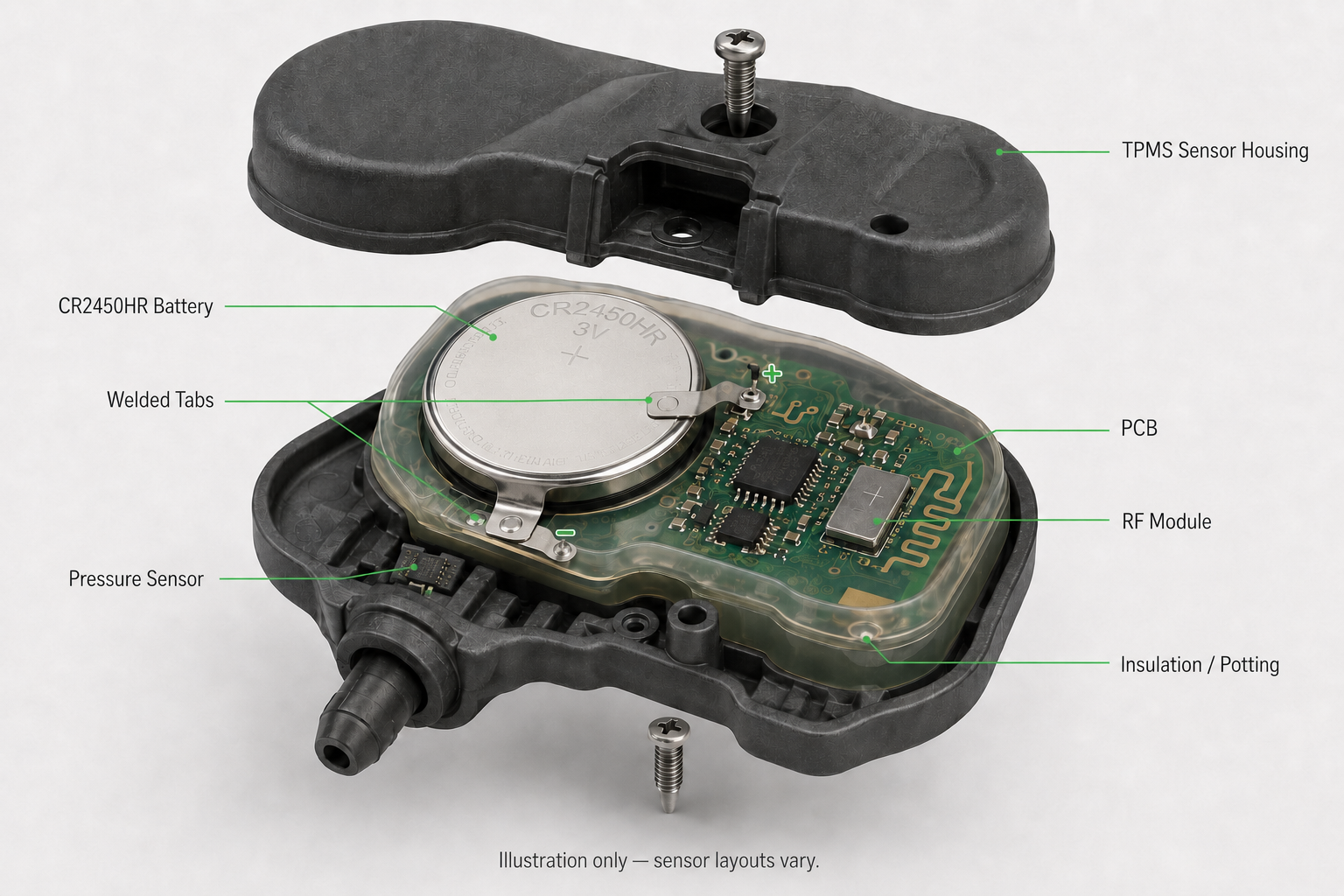
Figure 1. Illustration of a CR2450HR battery installed inside a generic direct TPMS sensor. Actual sensor layouts and terminal arrangements vary by model.
The battery therefore needs to support:
-
Long periods of low-power standby;
-
Short communication pulses;
-
Repeated hot and cold cycles;
-
Vibration and wheel acceleration;
-
Stable operation over a long service period;
-
Low leakage risk inside a sealed or potted sensor.
A standard CR2450 and a CR2450HR can have the same nominal diameter, height and voltage. That does not make them automatically interchangeable.
Standard CR2450 vs. CR2450HR
The table below compares published reference values for standard CR2450 and heat-resistant CR2450HR cells from the same manufacturer.
| Selection point | Standard CR2450 | Heat-resistant CR2450HR |
|---|---|---|
| Chemistry | Lithium manganese dioxide | Lithium manganese dioxide |
| Battery type | Primary, non-rechargeable | Primary, non-rechargeable |
| Nominal voltage | 3V | 3V |
| Nominal capacity | 610mAh | 550mAh |
| Nominal discharge current | 0.2mA | 0.2mA |
| Nominal size | 24.5 × 5.0mm | 24.5 × 5.0mm |
| Approximate cell weight | 6.5g | 6.8g |
| Published operating range | -30°C to +70°C | -40°C to +125°C |
| Published acceleration resistance | Not stated in the referenced standard-cell datasheet | Up to 2,000G |
| Main application positioning | General electronic devices | TPMS and other heat-resistant automotive applications |
| Direct TPMS replacement | Must be verified | Full specification and terminal match still required |
The standard CR2450 has a higher nominal capacity in these reference datasheets, but that does not mean it will provide longer service in a TPMS sensor.
Nominal capacity is measured under defined laboratory conditions. Actual TPMS performance is also affected by temperature, pulse load, cut-off voltage, self-discharge, aging and the sensor’s operating profile.
For TPMS applications, environmental performance, terminal design and verified sensor fit may be more important than a small difference in nominal milliamp-hours.
What Do T25, T23, T26 and T40 Mean?
Codes such as T25, T23, T26 and T40 identify terminal or finished-assembly versions associated with the CR2450HR cell. They do not represent different voltages or battery chemistries.
Official transport documentation lists complete versions including:
-
CR2450HR T25-03
-
CR2450HR SBO-T23
-
CR2450HR SBB-T26
-
CR2450HR HAB-T40
-
CR2450HR WK
The shortened terms “T23” or “T26” may help when searching, but they are not sufficient to confirm compatibility. Prefixes, suffixes and revision numbers can identify meaningful differences in the finished assembly.
The product comparison below shows how substantially the visible terminal construction can differ even when every assembly uses a CR2450HR cell.
The front and side views can help with initial identification, but they are not dimensioned engineering drawings. Final approval must still be based on the complete model code, polarity, dimensional drawing or confirmed physical sample.
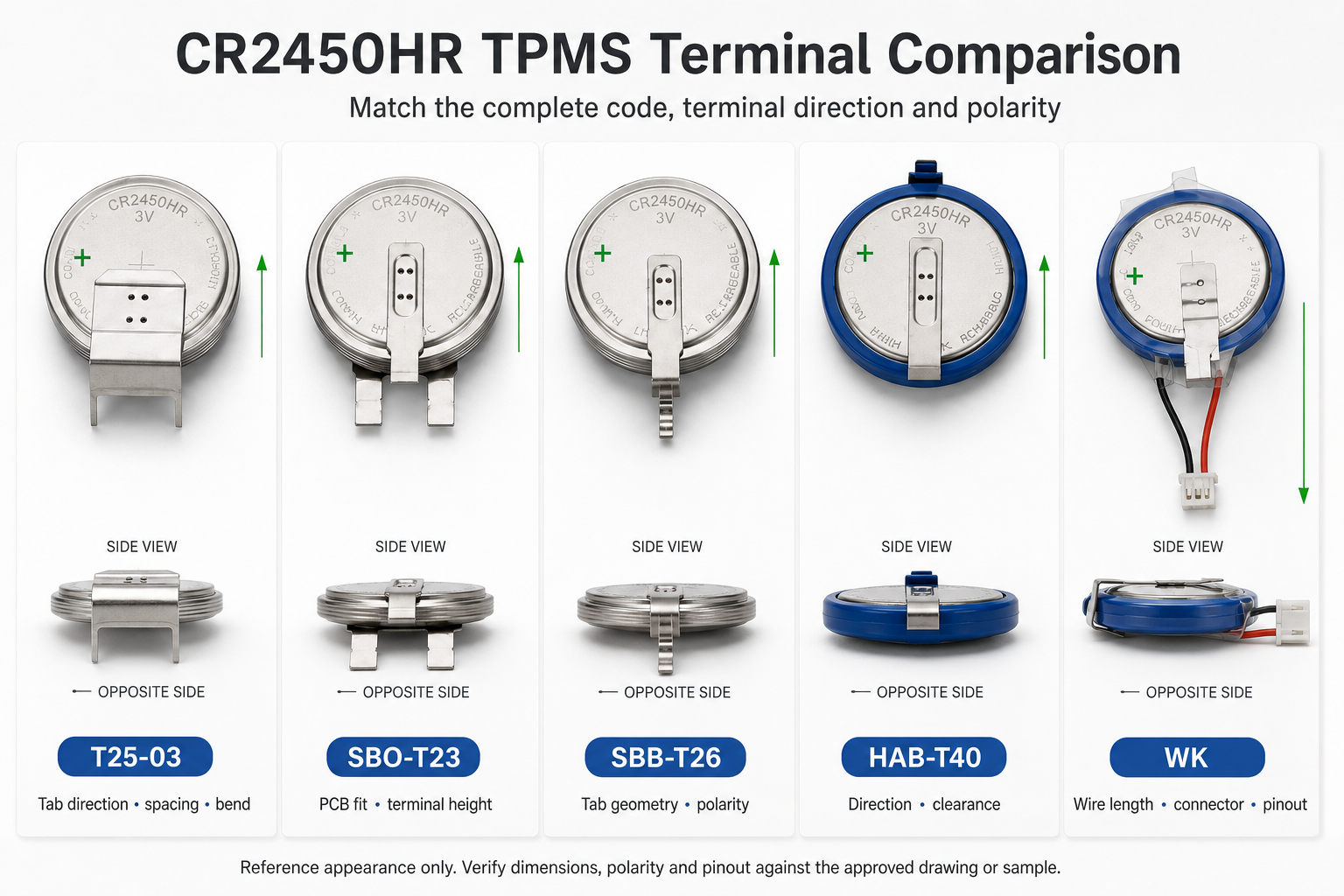
Figure 2. Visual comparison of common CR2450HR terminal and wire assemblies. Reference appearance only; verify dimensions, polarity and connector pinout against the approved drawing or sample.
| Model reference | What it identifies | What must still be verified |
|---|---|---|
| CR2450HR T25-03 | A specific T25 terminal version | Tab dimensions, orientation, spacing and polarity |
| CR2450HR SBO-T23 | A specific SBO-T23 assembly | Terminal position, PCB fit and mounting height |
| CR2450HR SBB-T26 | A specific SBB-T26 assembly | Tab geometry, polarity and soldering points |
| CR2450HR HAB-T40 | A specific HAB-T40 assembly | Mechanical fit, terminal direction and clearance |
| CR2450HR WK | A wired battery assembly | Wire length, connector model, latch direction and pinout |
| Custom version | Tabs, wires or connector made to requirement | Approved drawing, sample and validation standard |
These codes should be treated as manufacturer-specific drawing references rather than universal TPMS fitment codes.
A battery described by one supplier as “T25” should not automatically be assumed to match every other product sold under the same shortened description.
The safest approach is to compare the original battery against a dimensioned drawing or an approved physical sample.
If you cannot identify the terminal version, send Cowon clear photographs of the top, bottom and side of the battery, together with the TPMS sensor part number.
Six Details to Check Before Ordering
1. Confirm the Complete Part Number
Read every line printed or stamped on the original battery. Do not stop after “CR2450HR.”
Look for additional information such as:
-
T25-03
-
SBO-T23
-
SBB-T26
-
HAB-T40
-
WK or another wire designation
-
Production or revision codes
If the complete marking is no longer visible, photograph the battery and sensor from several angles before removing the battery.
2. Check the Terminal Orientation
Two tabbed batteries can look almost identical from above but differ when placed on the PCB.
Confirm:
-
Number of terminals;
-
Positive and negative terminal positions;
-
Tab direction;
-
Tab width and thickness;
-
Distance between terminals;
-
Bend location and angle;
-
Height above the cell surface;
-
Hole, slot or solder-pad dimensions.
The terminal comparison image provides a useful visual reference, but pin count alone does not confirm compatibility.
Two batteries with the same number of terminals may still have different polarity, spacing, tab direction and mounting height.
A reversed terminal arrangement can prevent installation or create a dangerous polarity error.
Do not rotate the battery or bend the tabs aggressively to make an incorrect version fit.
3. Check the Finished Assembly Size
The bare cell measures approximately 24.5mm in diameter and 5.0mm in height, but the installed space must also accommodate:
-
Welded tabs;
-
Insulation tape or sleeve;
-
Wires;
-
Connector housing;
-
Tab bends;
-
Solder joints.
Request a finished-battery drawing if the sensor housing has limited clearance.
This is especially important when the battery sits below a cover, against a molded support or beside an antenna or electronic component.
4. Verify Polarity and Connector Pinout
Wire colors are useful, but they are not a substitute for electrical verification.
For a battery fitted with a connector, confirm:
-
Connector manufacturer or equivalent series;
-
Number of positions;
-
Contact pitch;
-
Housing dimensions;
-
Locking-tab direction;
-
Wire specification;
-
Wire length;
-
Positive and negative pin positions.
Never assume that red and black wires use the same pin order as the original battery.
Verify the polarity against an approved drawing and, where appropriate, with a meter before connecting the battery to the sensor.
5. Review the Actual Temperature Requirement
The temperature inside a tire assembly is affected by:
-
Ambient conditions;
-
Vehicle speed;
-
Tire load;
-
Inflation pressure;
-
Braking heat;
-
Sensor position;
-
Duration of exposure.
A useful RFQ should state more than “high temperature.” It should include:
-
Minimum operating temperature;
-
Maximum continuous temperature;
-
Maximum short-term temperature;
-
Expected exposure time;
-
Storage temperature;
-
Sensor standby current;
-
Sensor pulse current;
-
Required service-life target.
If the operating condition exceeds 85°C, discuss the complete application with the battery supplier instead of relying only on the maximum catalogue rating.
6. Confirm Documentation and Validation
For commercial TPMS production or professional refurbishment programs, request the documents relevant to the project and destination market.
These may include:
-
Product datasheet;
-
Dimensional drawing;
-
Safety Data Sheet;
-
UN38.3 test summary;
-
IEC 60086-4 conformity information;
-
RoHS or REACH declaration;
-
Sample inspection report;
-
Lot traceability information.
A certificate for a bare cell does not necessarily cover every custom assembly.
Confirm that each document identifies the cell or finished configuration being shipped.
How Is TPMS Battery Life Estimated?
There is no universal service-life figure for every CR2450HR-powered TPMS sensor.
Annual mileage alone is not enough to calculate battery life. A technically useful estimate requires the complete sensor operating profile.
A simplified daily-consumption model is:
Daily consumption in mAh:
Daily consumption
= 24 × standby current
-
measurement events × measurement current × measurement duration ÷ 3,600
-
transmission events × transmission current × transmission duration ÷ 3,600
Where:
-
Current is expressed in milliamps;
-
Duration is expressed in seconds;
-
Measurement and transmission events are counted per day.
A simplified theoretical service-life estimate is:
Estimated life in years:
Usable battery capacity
÷ daily consumption
÷ 365
However, usable capacity should not automatically be set equal to the nominal 550mAh value.
The final estimate must consider:
-
Operating-temperature distribution;
-
Pulse-voltage performance;
-
Minimum sensor operating voltage;
-
Cell self-discharge;
-
Internal-resistance growth;
-
Storage before installation;
-
Safety margin;
-
Required end-of-life reliability.
For this reason, a statement such as “this battery lasts seven years” is not reliable unless it is supported by the sensor’s measured current profile and application validation.
The calculation model is useful for comparing designs, but physical testing in the actual TPMS sensor remains essential.
Why Factory-Attached Tabs Matter
Do not solder directly to the body of a coin cell.
Excessive heat can damage the battery seal or internal insulation and may cause leakage, overheating or other failures.
Published coin-cell safety instructions advise using batteries with terminals or leads prepared for the intended assembly process.
For production and professional refurbishment:
-
Use factory-welded tabs or leads;
-
Solder only to the designated terminals;
-
Control soldering temperature and duration;
-
Avoid repeated bending of welded tabs;
-
Inspect insulation and polarity before installation.
If a standard terminal does not fit, provide the supplier with a drawing or original sample and request a controlled custom assembly.
CR2450HR is a primary battery. It must never be recharged.
Common CR2450HR TPMS Battery Sourcing Mistakes
Ordering Only by Diameter and Voltage
“3V, 24.5mm coin cell” is not a complete TPMS battery specification.
It does not define temperature performance, pulse behavior, terminal construction, polarity or sensor fit.
Treating Every 550mAh Cell as Equivalent
Nominal capacity is measured under specific laboratory conditions.
Two cells with the same stated capacity may perform differently under temperature extremes, pulse loads or different cut-off voltages.
Ignoring the Full Terminal Code
T23, T25, T26 and T40 are not universal vehicle or sensor model numbers.
Use the complete assembly code and compare the drawing.
Assuming a Connector Fits Because It Has Two Pins
Two connectors can have the same number of pins but different pitch, housing shape, locking direction or polarity.
Soldering Directly to a Bare Cell
Use a factory-tabbed version. Applying a soldering iron to the cell body can damage the seal and creates unnecessary safety and consistency risks.
Advertising Universal Vehicle Compatibility
The same vehicle model may use different TPMS sensors across production years, markets and sensor suppliers.
Confirm the TPMS sensor part number rather than promising universal compatibility based only on the vehicle name.
Estimating Service Life from Nominal Capacity Alone
A 550mAh rating does not by itself determine how many years the battery will operate in a sensor.
Standby current, transmission profile, temperature and minimum operating voltage must also be considered.
What Information Should You Send to a TPMS Battery Supplier?
A complete enquiry saves several rounds of emails.
Send the following information whenever possible:
-
Complete original battery model;
-
TPMS sensor part number;
-
Clear photographs of both sides of the battery;
-
Side-view photographs showing the terminal height;
-
Photographs of the battery installed in the sensor;
-
Tab or connector dimensions;
-
Wire length and connector pinout;
-
Required quantity;
-
Target operating-temperature range;
-
Required certificates or transport documents;
-
Whether you need an existing version or a custom assembly.
For custom projects, a physical sample is often more reliable than photographs alone.
It allows the supplier to inspect the terminal layout, polarity, connector and available installation space before preparing approval samples.
Can CR2450HR Batteries Be Customized?
Depending on the project, a CR2450HR battery assembly may be supplied with:
-
Different welded-tab layouts;
-
PCB mounting terminals;
-
Insulation sleeves or protective tape;
-
Specified wire lengths;
-
Customer-selected connectors;
-
Defined positive and negative pin positions;
-
Custom packaging and labels.
Customization should begin with an approved drawing or original sample.
The completed sample must then be tested in the actual TPMS sensor before a production order is released.
Cowon provides CR2450HR 3V 550mAh TPMS batteries with multiple terminal, tab, wire and connector options.
For a faster recommendation, send us the complete original battery code, TPMS sensor part number and clear photographs of the battery from several angles.
You can also explore additional lithium manganese dioxide battery options for automotive, industrial and electronic applications.
Frequently Asked Questions
What is the best CR2450HR battery for a TPMS sensor?
There is no single terminal version that fits every TPMS sensor.
The correct battery must meet the required temperature and electrical specifications while matching the original terminal layout, polarity and installation dimensions.
Can a standard CR2450 replace a CR2450HR?
Not automatically.
Although both batteries may have the same nominal voltage and size, their operating-temperature ranges and environmental performance can differ. Use a battery approved for the sensor’s actual operating conditions.
What is the difference between CR2450HR T25 and T23?
The suffixes refer to different terminal or assembly designs.
Compare the complete part numbers, dimensional drawings, terminal orientation and polarity. They do not indicate different nominal voltages.
Are CR2450HR batteries rechargeable?
No. CR2450HR is a primary lithium manganese dioxide battery and must not be charged.
Can I solder wires directly to a CR2450HR cell?
Do not solder directly to the coin-cell case.
Use a battery with factory-attached tabs or leads and solder only to the designated terminals under an approved process.
How do I identify an unknown TPMS battery terminal?
Provide photographs of the battery from the top, bottom and side, together with the sensor part number and basic measurements.
If the marking is missing or the structure is difficult to measure, send the original battery or complete sensor as a sample.
Can a supplier make a CR2450HR battery with my connector?
In many cases, yes.
The supplier will need the connector model or sample, wire specification, required length, pin polarity and expected order quantity.
How long does a CR2450HR TPMS battery last?
There is no universal answer.
Battery life depends on the sensor’s standby current, measurement and transmission frequency, pulse-current profile, temperature, cut-off voltage, self-discharge and storage history. Use measured sensor data and an appropriate safety margin for estimation.
Final Selection Checklist
Before approving a CR2450HR TPMS battery, confirm:
-
3V lithium manganese dioxide chemistry;
-
Required capacity and discharge performance;
-
Operating and storage temperature ranges;
-
Cell and finished-assembly dimensions;
-
Complete terminal code;
-
Tab orientation and polarity;
-
Wire length and connector model;
-
Connector pinout;
-
Applicable documentation;
-
Sample performance in the actual sensor.
The model number identifies the battery family.
The complete terminal drawing, polarity, operating conditions and application test determine whether it is truly the correct TPMS battery.