EN
EN

News
Cylindrical vs. Prismatic vs. Pouch: Which Lithium Battery Reigns Supreme?
From the smartphone in your pocket to the electric vehicle in your garage, lithium-ion batteries are the silent workhorses of our electrified world. But have you ever considered the profound impact of their shape? The choice between a cylindrical, prismatic, or pouch battery isn't just about how it fits; it's a critical engineering decision that affects energy density, heat management, safety, and cost. In this deep dive, we'll unpack the unique characteristics of each form factor to reveal which design reigns supreme for different applications.
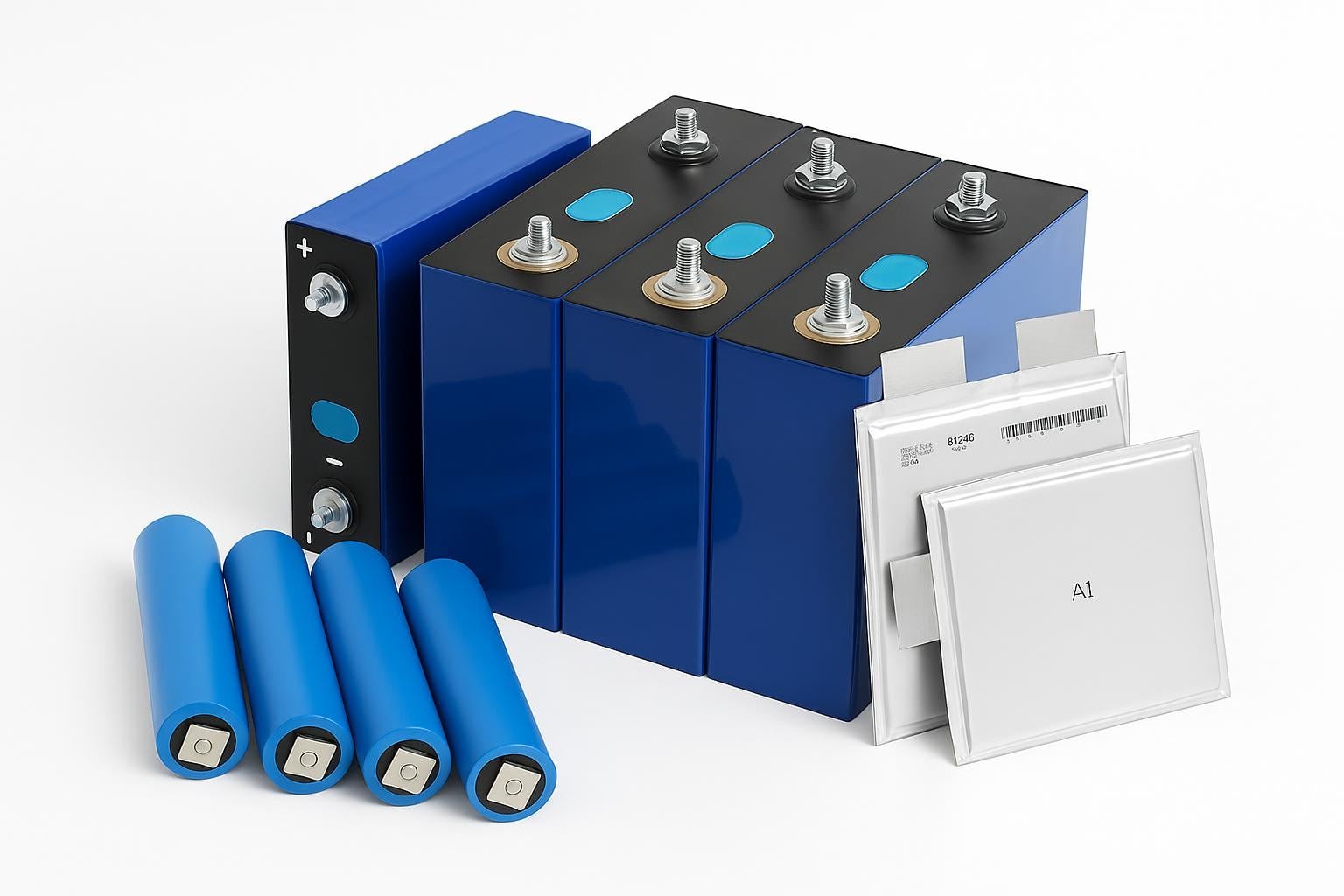
Comparison of cylindrical and prismatic lithium batteries
1. Battery shape: Square batteries can be designed in any size, unlike cylindrical batteries.
2. Rate performance: Due to the limitations of the welding process for multi-tabs in cylindrical batteries, the rate performance is slightly worse than that of prismatic multi-tab batteries.
3. Discharge platform: Lithium batteries using the same positive and negative electrode materials and electrolytes should theoretically have the same discharge platform, but the discharge platform of square lithium batteries is slightly higher.
4. Product quality: The manufacturing process of cylindrical batteries is relatively mature, the probability of secondary cutting defects in the electrode sheets is low, and the winding process is mature and highly automated. The stacking process is still carried out in a semi-manual manner, which has an adverse effect on battery quality.
5. Electrode welding: Cylindrical battery electrodes are easier to weld than square lithium battery electrodes; square lithium battery electrodes are prone to poor welding, which affects battery quality.
6. Pack assembly: Cylindrical batteries are easier to use, so the packing technology is simple and the heat dissipation is good; when packing square lithium batteries, the heat dissipation problem needs to be solved.
7. Structural characteristics: The chemical activity at the corners of square lithium batteries is relatively poor, and the energy density of the battery is prone to decay with long-term use, resulting in a shorter battery life.
Comparison of cylindrical lithium batteries and pouch lithium batteries
1. Soft-pack batteries have better safety performance. Soft-pack batteries are packaged in aluminum-plastic film. In the event of a safety problem, soft-pack batteries will generally bulge and crack, unlike steel-cased or aluminum-cased cells which may explode. In terms of safety performance, they are superior to cylindrical lithium batteries.
2. Soft-pack batteries are relatively lightweight, weighing 40% less than steel-cased lithium batteries of the same capacity and 20% less than cylindrical aluminum-cased lithium batteries; they also have lower internal resistance, significantly reducing self-discharge.
3. Pouch batteries offer superior cycle performance and a longer cycle life, exhibiting 4% to 7% less degradation after 100 cycles compared to cylindrical aluminum-cased batteries.
4. Pouch batteries also offer greater design flexibility, allowing for various shapes and thinner designs, and can be customized to meet specific customer needs, enabling the development of new cell models. Cylindrical lithium batteries, on the other hand, do not possess these advantages.
5. Compared to cylindrical lithium batteries, pouch cells have disadvantages such as poorer consistency, higher cost, and a greater susceptibility to leakage. The higher cost can be addressed through large-scale production, while leakage can be reduced by improving the quality of the aluminum-plastic film.