EN

News
Mitsubishi Outlander PHEV Battery Upgrade Guide: LEV40 Replacement with EVE 59Ah and CATL 51Ah Cells
Mitsubishi Outlander PHEV Battery Upgrade Guide: LEV40 Replacement with EVE 59Ah and CATL 51Ah Cells
Cowon | Technical buyer guide
Quick answer. For selected first-generation Mitsubishi Outlander PHEV battery packs originally built around LEV40-class prismatic cells, higher-capacity NMC cells such as the EVE M21-V1.2 59Ah and CATL 51Ah are potential candidates for an engineered upgrade. In an illustrative 80-cell series pack, these capacities correspond to approximately 17.6kWh and 15.1kWh of nominal energy, compared with approximately 12.0kWh for a 40Ah original pack. They are not confirmed plug-and-play replacements. The vehicle year, module construction, cell voltage limits, terminals, thermal behavior and battery management configuration must be checked before a retrofit is specified.
Owners of aging Outlander PHEVs often look for more electric-only driving and a practical alternative to replacing an entire traction battery. For repair workshops, the key question is more specific: which replacement cells can be fitted, monitored and operated safely in the existing vehicle? This guide explains the cell options, the energy calculation and the checks a professional integrator should complete.
Which Outlander PHEV Battery Is Being Upgraded?
The name “Outlander PHEV” covers different battery generations. Early first-generation vehicles used a nominal 12.0kWh traction battery. Mitsubishi increased the capacity to 13.8kWh in its updated 2019 model, while the all-new generation introduced in Japan in late 2021 moved to 20kWh. Model years and vehicle configurations differ by market, so the registration year alone is not a reliable identifier.
For the early LEV40-based configuration, the commonly referenced arrangement is 80 cells in series, grouped as ten eight-cell modules. A 40Ah cell at approximately 3.75V gives a simple nominal estimate of 80 × 3.75V × 40Ah = 12.0kWh. The manufacturer's usable-energy and operating-window settings are a separate matter.
Some later first-generation vehicles use a different battery version and LEV46-class cells. The discussion below therefore focuses on candidate upgrades for a verified LEV40-era pack, not on an automatic replacement for every Outlander PHEV, especially not the newer 20kWh generation.
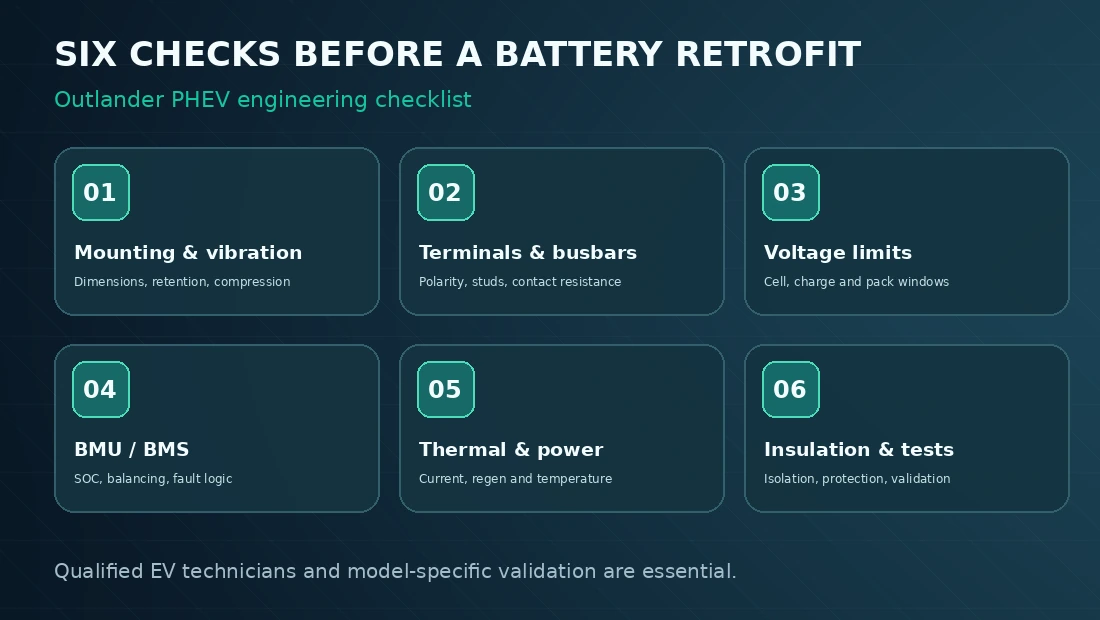
Concept illustration, not to scale. Candidate cells require mechanical and electrical evaluation.
Before ordering replacement cells, record the vehicle model year and chassis code, read the label on the existing module, confirm cell count and arrangement, and inspect a sample cell for its terminal layout and envelope. The original specification is the starting point for every compatible design.
EVE 59Ah vs CATL 51Ah: Two Prismatic NMC Candidates
Both options are higher-capacity lithium-ion prismatic cells that can be assessed for an Outlander upgrade project. They should be compared by a specific manufacturer part number and revision, not only by the headline ampere-hour rating.
|
Item |
Original LEV40 class |
CATL 51Ah class |
EVE M21-V1.2 59Ah |
|
Nominal cell capacity |
Approx. 40Ah |
51Ah |
59Ah at specified test rate |
|
Nominal voltage used for illustration |
3.75V |
3.7V assumed |
3.73V |
|
Illustrative 80-cell nominal energy |
12.0kWh |
15.1kWh |
17.6kWh |
|
Physical cell format |
Original prismatic module cell |
Prismatic NMC; verify exact drawing |
Prismatic NMC, approx. 148.6 × 26.7 × 99.2mm including terminals |
|
Retrofit status |
Reference configuration |
Engineering evaluation required |
Engineering evaluation required |
The EVE M21-V1.2 is the specifically identified model on Cowon's EVE 59Ah prismatic battery cell product page. Its compact format and high nominal energy make it interesting when a workshop is designing new supports and electrical connections. Confirm the exact terminal option and the manufacturer's approved compression and electrical limits for the batch being sourced.
Cowon also offers a CATL 51Ah NMC prismatic battery cell. The 51Ah class may suit a project that prefers a smaller increase in nominal capacity. Although this product is marketed for Outlander PHEV battery projects, the exact CATL model and revision, voltage window, current ratings, terminal layout and dimensioned drawing should be confirmed before comparing mechanical fit or declaring vehicle compatibility. The illustrative 3.7V figure in the table is not a verified manufacturer specification for the delivery batch.
A higher Ah value is not an installation certificate. Mechanical shape, battery management limits, power capability, thermal behavior and professional validation matter as much as nominal capacity.
How Much Nominal Energy Could an 80-Cell Upgrade Provide?
The theoretical energy of a series battery is calculated as the number of series cells multiplied by nominal cell voltage and cell capacity. In series, the ampere-hour capacity stays the same while voltage adds.
Nominal energy (Wh) = Series-cell count × Nominal cell voltage (V) × Cell capacity (Ah).
Original reference: 80 × 3.75V × 40Ah = 12,000Wh, or 12.0kWh.
CATL 51Ah illustration: 80 × 3.7V × 51Ah = 15,096Wh, or about 15.1kWh.
EVE M21-V1.2 illustration: 80 × 3.73V × 59Ah = 17,605.6Wh, or about 17.6kWh.
Relative to the nominal 12.0kWh reference, the 51Ah illustration represents approximately 26% more nominal energy, and the 59Ah illustration represents approximately 47% more. These are capacity-based engineering comparisons, not verified battery pack outputs or real-world driving-range promises. If the BMS restricts state of charge, if cell voltage limits differ, or if temperature and power demands are unfavorable, usable energy will be lower.
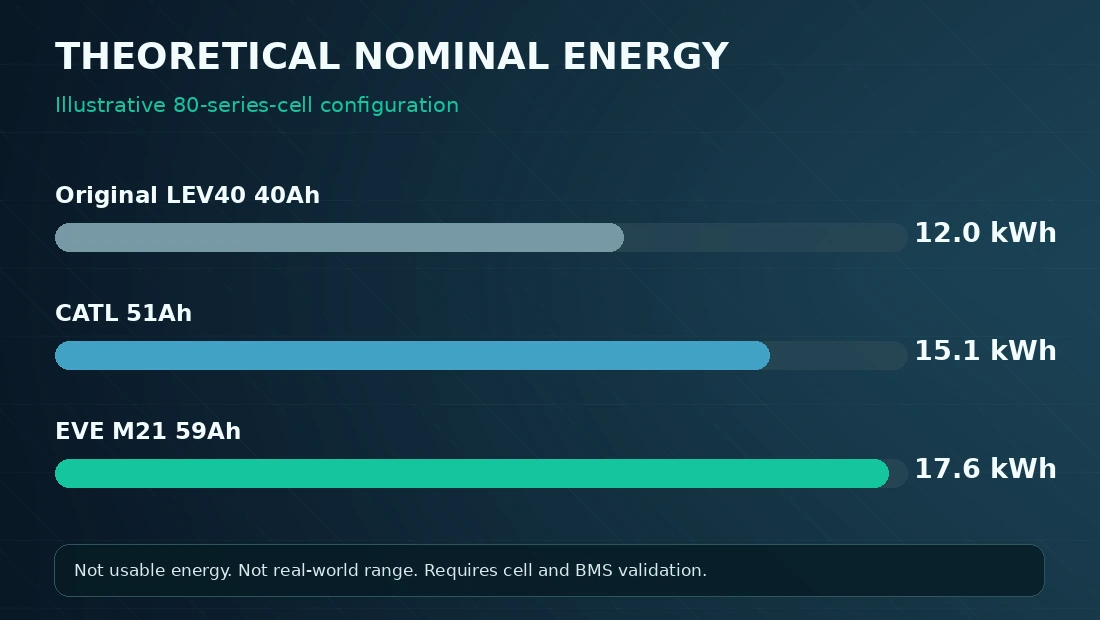
Calculated nominal energy only; not usable capacity or verified driving range.
It is tempting to turn a 47% energy increase into a claim of 47% more electric-only kilometers. That is not technically justified without vehicle tests. Driving conditions, battery temperature, pack aging, engine control strategy, vehicle software and the actual usable SOC window all affect range.
Why LEV40 Replacement Is Not a Direct Cell Swap
A replacement cell can be smaller than the original and still be unsuitable. In an automotive traction battery, every difference can influence reliability and safety. Professional integration should cover at least six areas.
1. Mechanical retention and vibration
Check dimensions with tolerances, terminal height, expansion and compression requirements. Different cells may need engineered insulating frames, secure retention, compatible pressure control or new busbars. An improvised loose fit inside an old module is not acceptable.
2. Terminals and connection resistance
Compare polarity, stud or weld configuration, bolt spacing, contact surfaces and current paths. A similar-looking terminal does not mean the original busbar can be reused safely. Qualified assembly methods and properly specified joints are essential.
3. Cell voltage limits and charging control
The EVE M21-V1.2 technical information lists a cell upper charging limit that must be assessed against the Outlander battery management strategy. A cell's maximum permitted voltage is not permission to raise the vehicle's pack voltage. Confirm the allowed cell voltage window, charging behavior, balancing thresholds and total pack operating limits before proceeding.
4. Battery monitoring and capacity estimation
The vehicle's BMU and cell monitoring system must correctly interpret voltage, temperature, current, available capacity and SOC. New cells may require qualified calibration or other validated integration work. Changing the Ah figure without confirming vehicle behavior can lead to inaccurate range estimates, fault codes or protective intervention.
5. Power demand and temperature
A traction application needs more than adequate stored energy. Evaluate discharge and regenerative-charge currents over the full SOC and temperature range, along with contact resistance, cooling and cell-to-cell consistency. Never treat an advertised cell-level peak-current figure as a guaranteed continuous current for a finished automotive battery pack.
6. Electrical isolation and final validation
Insulation, enclosure integrity, crash retention, protective devices, wiring and vehicle-specific diagnostics must remain effective. High-voltage battery work should be carried out by qualified EV technicians using the correct procedures and protective equipment.
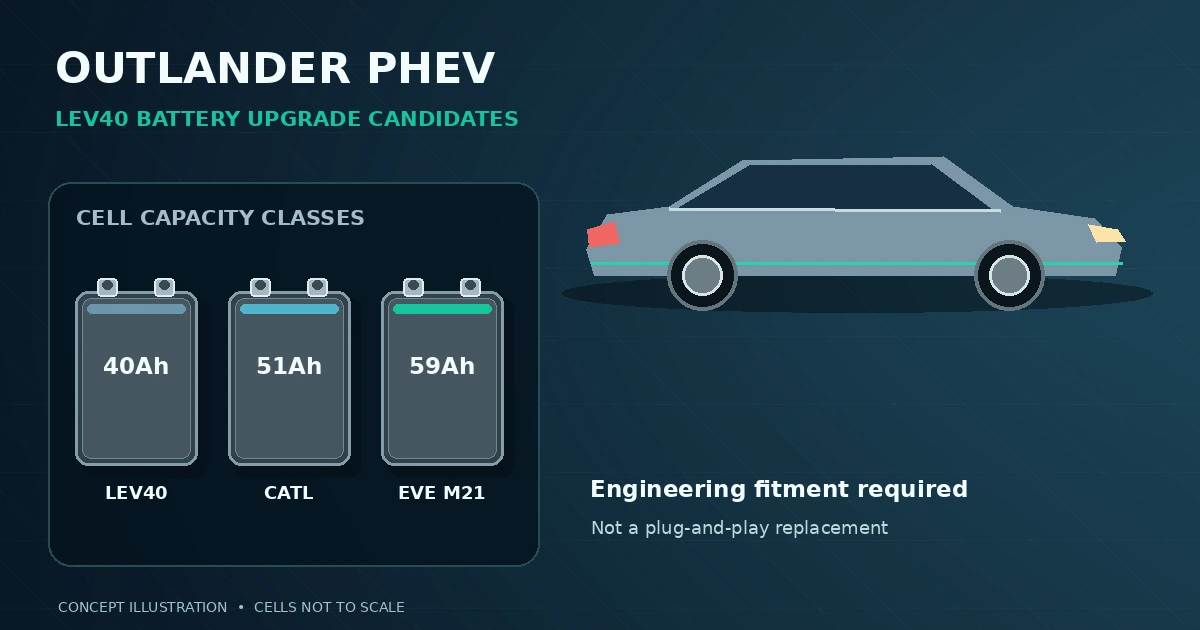
A system-level compatibility checklist for qualified EV repair workshops.
Which Candidate Should a Workshop Evaluate First?
The answer depends on the vehicle and the project objective. The table below is a decision framework, not a claim that either candidate has already passed vehicle-level qualification.
|
Project priority |
Reason to investigate |
Critical question before ordering |
|
Moderate energy increase |
CATL 51Ah class offers an intermediate nominal-capacity step |
Which exact cell revision, voltage window and terminal specification will be supplied? |
|
Maximum nominal energy from these two choices |
EVE M21-V1.2 59Ah gives more nominal Wh per series position |
Can the larger energy option be operated within the vehicle's validated electrical and thermal limits? |
|
Retain original module hardware |
Neither candidate should be assumed to fit directly |
Are spacers, supports, busbars and validated mounting methods available? |
|
Minimize project uncertainty |
Select a tested configuration with documented evidence |
Is there a completed, model-specific retrofit test report and workshop support? |
For a commercial repair shop, the best procurement package includes an exact model datasheet, a dimensioned terminal drawing, production-batch traceability, matched cells, capacity and resistance test evidence, and agreed responsibility for the vehicle integration. The cheapest cell-only quote may not be the lowest-risk project.
A Practical Procurement Checklist for Repair Workshops
Before requesting a quotation, collect the following information:
Vehicle model year, market and chassis code, such as GG2W or GG3W where applicable.
Original pack capacity, original cell label and clear module photographs.
Series cell count, module arrangement and whether all cells or only a diagnosed module are to be replaced.
Original cell dimensions, terminal orientation, hole spacing and electrical connections.
Desired candidate: EVE M21-V1.2 59Ah or a verified CATL 51Ah part number.
Required quantity, destination country and any documentation or test reporting needed.
Whether a qualified workshop has a validated plan for BMU/BMS compatibility, assembly and final tests.
Avoid mixing different capacities, ages or electrochemical characteristics within a high-voltage pack unless an engineering design and validation specifically supports the arrangement. For a complete conversion, cell matching and system testing are normally major work items rather than optional extras.
Frequently Asked Questions
How many battery cells are in an early Outlander PHEV pack?
A commonly documented early first-generation configuration uses 80 series-connected cells in ten eight-cell modules. Confirm the exact configuration against your vehicle before ordering. Different Outlander PHEV generations are not identical.
Can I replace LEV40 with EVE 59Ah without changing anything else?
Do not assume so. Dimensional, terminal, isolation, thermal and BMU/BMS differences require an engineering review. A successful cell selection is only one part of a safe battery upgrade.
Is CATL 51Ah or EVE 59Ah better for electric range?
In the illustrative 80-cell calculation, the 59Ah option has higher nominal energy. Actual usable energy and driving range cannot be guaranteed from the cell's Ah rating alone. An integrator should check the whole system and verify it in the vehicle.
Does this guide cover 2019 or newer Outlander PHEV models?
Not as a direct-fit recommendation. Mitsubishi changed the first-generation pack to 13.8kWh for its 2019 model and later introduced a 20kWh second-generation pack. The correct original cell and battery architecture must be identified for each variant.
Can individual cells be mixed with the remaining old LEV40 cells?
Mixing new high-capacity cells with aged cells of different impedance and capacity can create imbalance and monitoring problems. A qualified battery engineering assessment is required; it should not be treated as a routine drop-in repair.
What should I send Cowon for a battery-cell quotation?
Send your vehicle details, original-cell or module photographs, preferred candidate, target quantity, terminal requirements and destination. Cowon can discuss cell sourcing and specifications; vehicle-level approval, high-voltage installation and validation must be established separately with the responsible professional integrator.
Next Step: Evaluate the Right Battery Cells for Your Project
An Outlander PHEV battery upgrade begins with the correct original pack identification and a fully specified replacement cell. The EVE M21-V1.2 59Ah and CATL 51Ah NMC cells offer two useful capacity classes to investigate, but neither should be purchased on nominal capacity alone.
Explore Cowon's EVE 59Ah M21-V1.2 cell and CATL 51Ah prismatic cell, then contact Cowon with your vehicle and cell requirements. For another Mitsubishi electrification project, see our i-MiEV LEV50 to 93Ah battery upgrade guide.
Technical references: Mitsubishi Motors' 2019 Outlander PHEV launch information (12.0kWh to 13.8kWh); GS Yuasa EV/PHEV battery product information; the EVE 59Ah and CATL 51Ah Cowon product listings linked above. Energy examples are calculations, not retrofit test results. Confirm manufacturer datasheets and vehicle-specific service literature before work begins.