EN
EN

News
Lithium Polymer Batteries: Uncompromising Power for Your Professional Devices
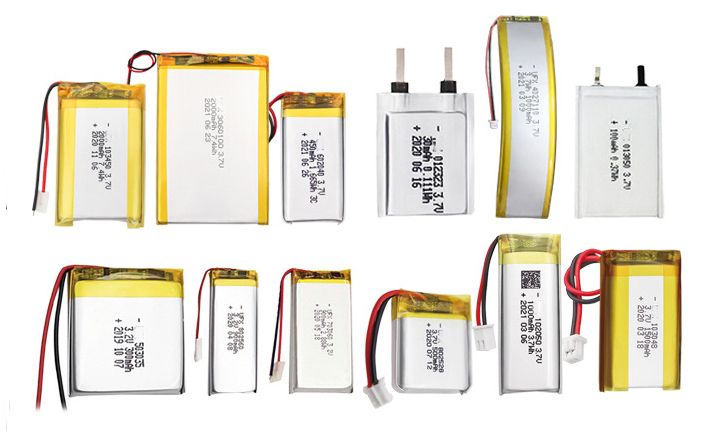
lithium Polymer batteries are lithium-ion batteries that use polymers as electrolytes or key structures. Their core characteristic is that the form of the electrolyte is different from that of conventional liquid lithium-ion batteries.
lithium Polymer batteries are generally used in portable devices (such as mobile phones and laptops), applications with high safety requirements (such as medical devices and drones), and special-shaped devices (such as devices as thin as a credit card and flexible electronic products).
1. Definition and characteristics of lithium Polymer batteries
Polymer
lithium-ion batteries use solid or colloidal polymer materials (such as gel polymers) as their electrolyte, replacing the liquid electrolyte in traditional liquid lithium-ion batteries. Some types also have polymers (such as PVDF) coated on the separator to enhance adhesion (semi-polymer) or form a gel network (full polymer), reducing the amount of liquid electrolyte used and improving safety.
The structural design
uses an aluminum-plastic flexible packaging film (composed of PP, Al, and nylon layers) as the outer shell, known as a soft-pack battery. Compared to the metal shell of liquid batteries, it is lighter, thinner, and more flexible. Its thickness can be less than 0.5mm, and it can be customized into any shape (such as trapezoidal, ultra-thin card, etc.) to meet the needs of special equipment.
performance advantages
Safety: Because the electrolyte is not easily leaked and the outer casing can expand to release pressure, even in the event of a malfunction, it usually only bulges rather than explodes.
Energy density: 10%-30% higher than traditional liquid batteries, and 20%-40% lighter (no metal casing).
Cycle life: Over 500 cycles under normal use, with low self-discharge rate and no memory effect.
2. Differences from other lithium-ion batteries
|
Comparison Dimensions |
lithium Polymer batteries |
Liquid lithium-ion batteries |
|
electrolytes |
Solid/colloidal polymer electrolytes, some containing small amounts of liquid components. |
Liquid electrolyte (flammable) |
|
Security |
It is not prone to explosion; when it malfunctions, it often manifests as gas bulging. |
Relatively poor security |
|
Shape and thickness |
Ultra-thin (<1mm), customizable to any shape |
Generally, it has a relatively large thickness and a fixed shape. |
|
Weight and capacity |
With the same volume, it has 10%-15% higher capacity and is 20%-40% lighter. |
Capacity and weight are limited by the metal casing. |
|
Voltage and Combination Method |
A single cell can achieve higher voltages (multi-layer structure). |
Multiple cells need to be connected in series to achieve high voltage. |
|
cost |
High manufacturing costs (technologically complex) |
Low cost and mature technology |
3. Summary
lithium Polymer batteries, through electrolyte and structural innovations, significantly outperform traditional liquid batteries in safety, thinness, and energy density, but are more expensive. Their technological characteristics make them ideal for high-end electronics and emerging fields such as flexible devices, while liquid batteries still maintain a cost advantage in the low-to-mid-range consumer battery market.