EN

News
Medical Regulatory Compliance for Lithium-Ion Battery Packs: A Practical OEM Guide
Medical Battery Compliance
Medical Regulatory Compliance for Lithium-Ion Battery Packs: A Practical OEM Guide
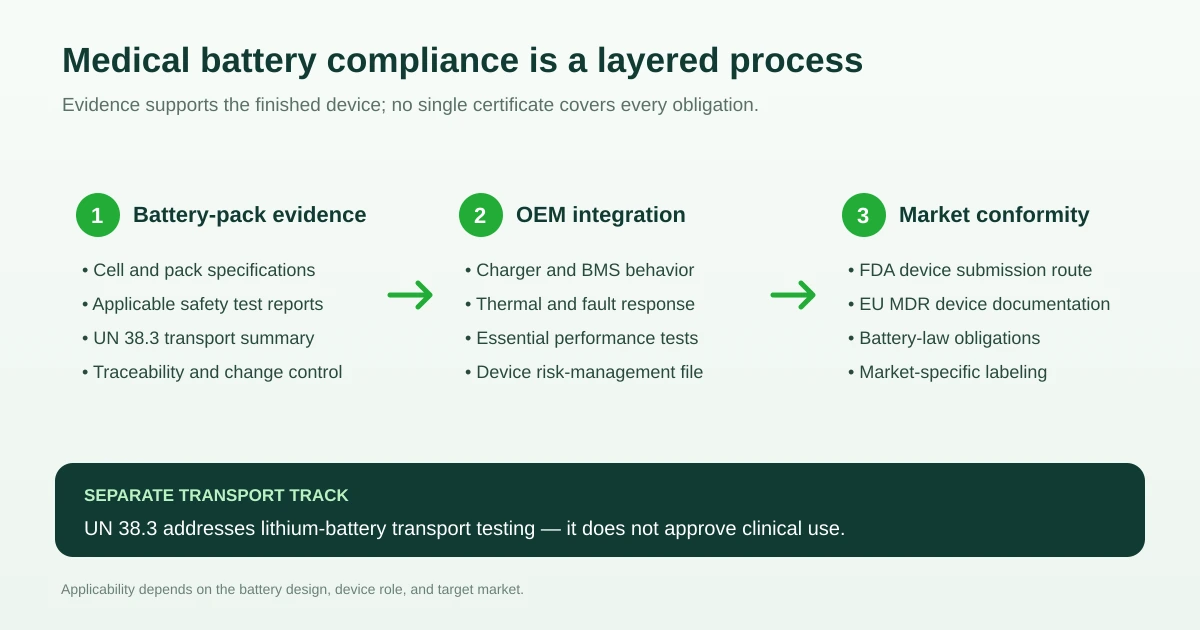
There is no single “medical battery certificate” that makes every lithium-ion pack compliant worldwide. The right evidence depends on the battery design, the medical device that uses it, the target markets, and how the pack is supplied.
1. Start by defining what is being placed on the market
A lithium-ion battery pack may be sold as a component for integration, supplied as a replacement for a named device, or marketed as a battery product in its own right. Those situations do not automatically follow the same conformity route. Before requesting a quote or planning tests, record the intended use, whether the pack is rechargeable, its cell configuration, whether it contains a battery-management system (BMS), the host device, and the countries where the finished equipment or battery will be sold.
For an OEM project, the battery is part of a larger safety case. The finished equipment may need to be evaluated for electrical safety, essential performance, charging behavior, abnormal conditions, temperature rise, electromagnetic compatibility, and foreseeable misuse. The device manufacturer decides which requirements apply and how evidence is assembled. A battery supplier should support that work with accurate, configuration-specific documents.
This distinction prevents a common mistake: treating a cell report, a transport test summary, or a supplier quality certificate as proof that the complete medical device is compliant.
2. Which standards and rules may matter?
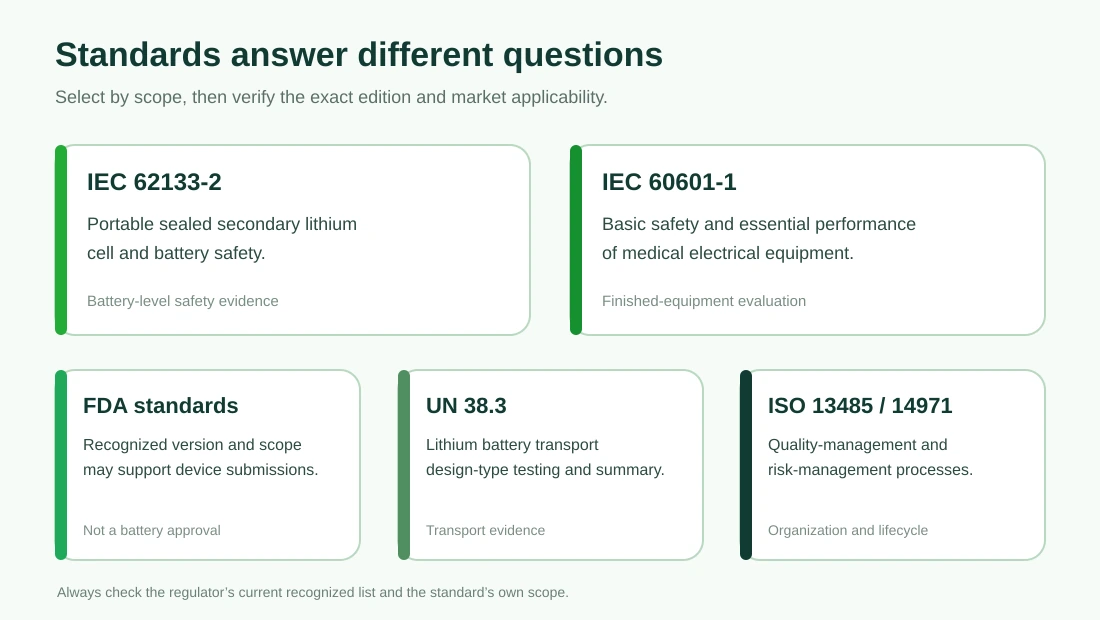
The names often appear together in supplier questionnaires, but they answer different questions. The table is a planning map, not a universal checklist. Confirm the current edition, recognition status, scope, and applicability for the specific device and market.
| Reference | What it addresses | What it does not establish by itself |
|---|---|---|
| IEC 62133-2 | Safety requirements and tests for portable sealed secondary lithium cells and batteries under intended use and reasonably foreseeable misuse. | It is not a medical-device market approval and does not replace evaluation of the pack inside the host device. |
| IEC 60601-1 | Basic safety and essential performance of medical electrical equipment and medical electrical systems. Relevant battery behavior is evaluated as part of the equipment design, with applicable collateral or particular standards considered. | It is not a stand-alone certificate for every battery pack. The applicable device standard and test plan depend on the product. |
| FDA-recognized consensus standards | In the United States, manufacturers may use an FDA-recognized standard, in its recognized version and scope, to support relevant parts of a device submission. | FDA recognition of a standard is not FDA approval or certification of a battery. Check the live database and the standard’s supplemental information sheet. |
| EU MDR and EU Battery Regulation | The MDR governs conformity of medical devices. Regulation (EU) 2023/1542 creates separate obligations for batteries within its scope, including conformity assessment and technical documentation where applicable. | One regulation’s evidence does not automatically satisfy the other. Confirm which economic operator and product configuration carry each obligation. |
| UN Manual of Tests and Criteria, subsection 38.3 | Transport testing for lithium cell and battery designs, with a test summary made available in the supply chain. | UN 38.3 is a transport requirement; it is not an operational medical-device safety approval. |
| ISO 13485 / ISO 14971 | ISO 13485 concerns quality-management systems for medical-device organizations. ISO 14971 provides a risk-management process for medical devices across the lifecycle. | Neither is a product-level battery certificate. The OEM determines how supplier controls and battery hazards fit its quality and risk files. |
3. Build a market-specific compliance plan
United States: check the device pathway and FDA-recognized version
FDA’s standards program lets device manufacturers submit declarations of conformity to standards that FDA has recognized, subject to the recognized edition and any limitations. FDA may recognize all, part, or none of a standard. The database should be checked when the submission is prepared; a newer published edition is not automatically the FDA-recognized edition. The battery evidence supports the device manufacturer’s assessment—it does not turn the battery into an “FDA-approved battery.”
For a powered medical device, the engineering team should map the battery to the finished-device safety and performance plan. That plan can include the charger, BMS, firmware or gauge behavior, electrical protection, temperature sensing, and the device’s response to low voltage or a battery fault.
European Union: distinguish medical-device and battery obligations
Under the EU Medical Device Regulation (MDR), the medical-device manufacturer is responsible for the device’s conformity assessment, technical documentation, declaration of conformity, and CE marking when applicable. Regulation (EU) 2023/1542 is a separate battery framework. Where a battery falls within its scope, its manufacturer has battery-specific conformity, documentation, marking, and identification duties. Map the roles before launch: “the medical device has CE marking” and “the battery meets applicable battery rules” are related statements, not interchangeable ones.
Battery removability requirements are another area where blanket claims can mislead. The European Commission identifies medical devices among products with exemptions from certain portable-battery removability requirements. Confirm the exact provision and current guidance for the product; do not assume that every medical pack must be user-replaceable on a single date.
Global shipping: keep transport evidence separate
Lithium-ion cells and batteries offered for transport are subject to the applicable dangerous-goods rules. UN 38.3 evidence concerns the tested battery type and transport classification. Keep the matching test report and test summary available, and verify that the model, configuration, and report revision correspond to the battery being shipped. A test on a cell does not automatically cover every assembled pack design.
4. What should a battery supplier’s evidence package contain?
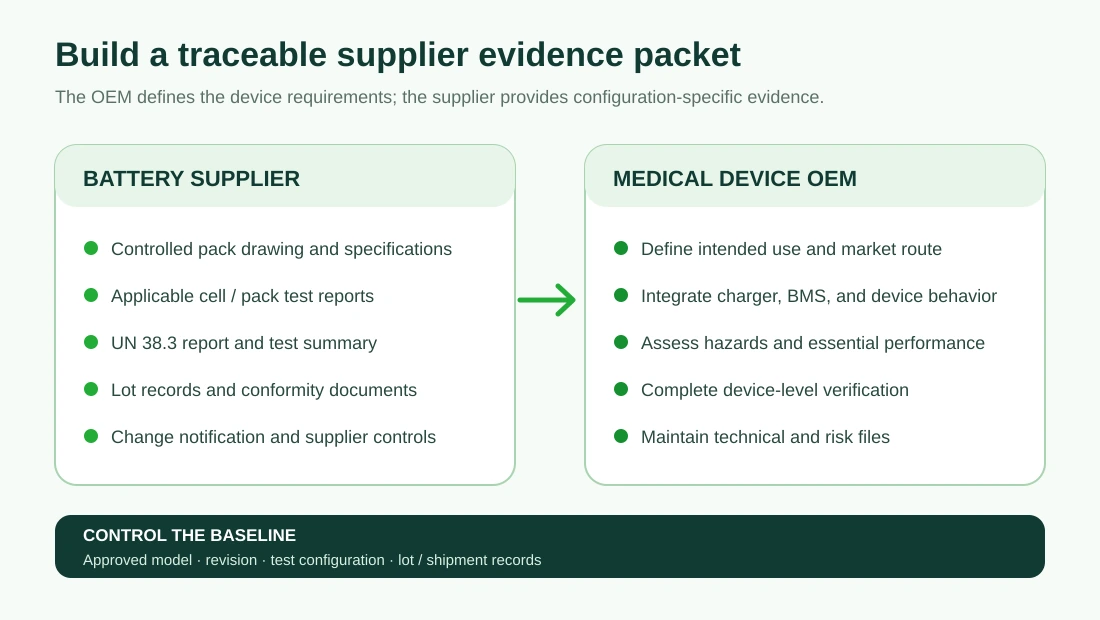
Agree on the document list before design freeze. The exact package varies, but an OEM commonly needs the following:
- Product definition: controlled drawing, model number, cell chemistry and configuration, rated voltage and capacity, dimensional limits, connector and pinout, BMS functions, and approved charging limits.
- Safety and transport evidence: applicable cell or pack test reports, the relevant IEC 62133-2 evidence where applicable, UN 38.3 report and test summary for transport, and safety data or shipment documents required for the route.
- Manufacturing controls: incoming inspection criteria, end-of-line test records, lot or serial traceability, certificate of conformity, change-notification rules, and a process for handling nonconforming product.
- Integration data: charge and discharge limits, temperature-sensor behavior, protection thresholds, communication protocol or fuel-gauge data, and known limitations needed for device-level risk analysis and verification.
- Quality and risk records: supplier quality-system information and hazard-control evidence that the OEM can evaluate within its own ISO 13485 and ISO 14971 processes.
Make the records configuration-specific. If the cell, BMS, firmware, connector, enclosure, or manufacturing site changes, assess whether prior testing and approvals remain valid before shipping the revised pack.
5. A practical project sequence
- Map the product: identify the host device, battery role, target markets, rechargeable chemistry, pack configuration, and responsible legal manufacturers.
- Set the evidence matrix: assign each requirement to the battery supplier, device OEM, test laboratory, or importer. Record which standard edition and market rule are being used.
- Freeze the design baseline: approve the cell, BMS, charger interface, drawing, labels, and critical suppliers before formal testing.
- Verify the finished system: run the risk-based device-level tests required by the OEM’s regulatory and engineering plan. Component reports do not replace integration testing.
- Maintain compliance in production: control revisions, retain lot records, review supplier changes, and keep shipment documentation aligned with the exact battery model.
6. Common compliance mistakes to avoid
- Calling a battery “FDA certified” because an individual standard appears in an FDA database.
- Using IEC 60601-1 as if it were a stand-alone battery-pack certificate, or assuming IEC 62133-2 alone validates the finished medical device.
- Describing UN 38.3 as a medical-use safety approval rather than transport evidence.
- Assuming a cell test report covers a pack with a different series/parallel arrangement, BMS, enclosure, or manufacturer.
- Using a certificate without checking its exact model, test configuration, edition, laboratory, and scope.
- Making universal cost or timeline promises before defining the market, device class, test plan, and required evidence.
FAQ
Does a lithium-ion battery pack need its own medical-device CE mark?
Not as a universal rule. The EU MDR applies to medical devices; the EU Battery Regulation may create separate battery obligations depending on the product and its role. Determine the applicable legal framework and responsible manufacturer for the exact configuration.
Is IEC 62133-2 enough for a battery used in a patient monitor?
No. It addresses safety of portable sealed secondary lithium cells and batteries. The finished monitor still needs the device-level assessment required for its intended use and target market.
Does UN 38.3 prove the pack is safe during clinical use?
No. It addresses lithium-battery transport testing. Clinical-use and equipment-integration safety are evaluated through the applicable device and battery design processes.
What should we send a supplier for an initial compliance review?
Share the host-device model and intended use, battery drawing or label, cell and pack configuration, charging method, target markets, planned production volume, and the documents your regulatory team requires. The supplier can then confirm what evidence is available and what remains to be verified.
Discuss a Medical Battery Pack Project
For a replacement or OEM program, send the battery model or part number, host-device model, target markets, pack drawing or label photos, and required documents. Cowon can review the available medical battery options and identify the technical details that need confirmation.
Browse CowonTech medical equipment batteries · Contact CowonTech
Technical references
- FDA: Division of Standards and Conformity Assessment and Recognized Consensus Standards database.
- IEC 62133-2:2017+AMD1:2021 and IEC 60601-1:2005+AMD1:2012+AMD2:2020.
- EU Medical Device Regulation (EU) 2017/745 and EU Battery Regulation (EU) 2023/1542.
- UNECE Manual of Tests and Criteria, Revision 8 and Amendment 1.
- ISO 13485:2016 and ISO 14971:2019.
- European Commission: exemptions to portable-battery removal rules.
This article is a technical planning overview, not a determination of regulatory status for a specific product. Confirm current requirements, recognized editions, and conformity routes with the device manufacturer and qualified regulatory specialists.